There's probably no surprise to the idea that people who sell stuff on the streets of the Latin America are something common. I personally find it interesting how hawkers, peddlers, or however you want to call 'em are big parts of Latino culture, and so, it is interesting hearing songs about them in popular styles of music from several countries. So far I found songs from Mexico, Chile, Venezuela, and Paraguay, but I'm sure that if I dug a bit deeper I'd be able to find references to them in songs of just about every Hispanophone country. So, without further ado:
Oscar Padilla - El Tamalero (from Mexico)
Pedrito Altamiranda - El Buhonero (Panama)
Banda MS - Cacahuates Pistaches (Mexico)
Juana Fé - Callejero (Chile)
Radio Rochela - Adiós Buhonero (Venezuela)
(this last one reminds me of Saturday Night Live with its air of parody).
Mostrando entradas con la etiqueta music. Mostrar todas las entradas
Mostrando entradas con la etiqueta music. Mostrar todas las entradas
domingo, 25 de septiembre de 2011


miércoles, 29 de diciembre de 2010
A Couple Reviews for my Album & Advice for Beginning Musicians
A problem with releasing my online CD, I found, was that getting feedback on it wasn't always easy until you specifically asked. Recently, I just went straight to the point on a post on DeviantArt and, hooray, a couple people gave me some wonderful, hilarious, silly or smart, very helpful or not comments. All of them brutally honest, as I asked them to. Down below I have selected some of the things that have been said, and, to be honest, I totally agree with the criticism I've been given. Reading these has helped me focus on what areas I need to improve and which are my strong points, so when I begin working on the next CD, I will know how to take my music as far as I can (well, at least a bit more, thank you all for commenting!)
So.. oh yeah, comments and reviews (by people I know and by total strangers):
So, with all that said, I realise the follwing key points:
So.. oh yeah, comments and reviews (by people I know and by total strangers):
this has to be one of the weirdest things I have heard all year. Congrats, you managed to combine annoying and boring in a completely new way.
– Morthax
very tight songwriting
it should sell
but I’m afraid its not poppy and simple enough
- ttwoo
Oh man, I think I'm sold. I'm not even halfway through the first track, either. Very nice!
– napalmpotato
First off, this music really isn't my thing, with that said, I enjoyed it for a bit...it was very creative.
The mix on your first track seems to be overdriven a bit, were you going for that? It was distracting.
I liked the MJ samples in Bricktop, I didn't like Itchy Bitchy Spider at all, but the mix was decent on those two songs.
I didn't bother listening to the rest because I had lost interest at the 3:30 mark of IBS after the solo (which was appetizing). Good work though
– Arkayem
love the first song, LOVE the drum quality
Lets a goin down remix is SOOO good
your music
cept for the videogame metal
all amazing
videogame metal was a fail in my opinion
like how u mixed both michael jackson and old 40's jazz
[this] music is good study music
u sound like goofy in the daniel song
what the fuck were u thinking about when u wrote the lyrics?
love the break downs of the song song
Jamón Serrano is sooo good
I think I’m addicted [to it]
I just realized
Ur voice sounds like Sean Paul
Mixed with the singer of Rammstein”
I love the vocals for Crazy With the Hues
eni-mini-miny-mo, catch michael jackson by the toe??
– D. T.
from my point of view ur music is very complex and extended. i rlly like it that way. its enjoyable when i wander off and get into the music.
– B. T. (no, not the DJ)
Just checked out the first song - so far, it sounds nice. I would have mixed the drum/percussion samples a bit further back myself, might just be a matter of preference though (I'm a drummer, the beats got me air drumming :D I like snares in those nonstandard places)...
The beginning of the second song reminded me a bit of Autechre, always good as far as I'm concerned... I'll have a corn muffin or three or four and get to it and the others on a fuller stomach...
I'm on Any Day Today, which would, should, and absolutely wants to be a great song, maybe somewhere between Pink Floyd and Modest Mouse vibewise, tarnished greatly by too many effects on the vocals... your voice is solid, don't be afraid of your voice! Don't get in the way of the listener connecting with the most human and accessible part of the music! Some compressors on the vocals to control dynamics should be plenty...
The first two songs and the last three songs (especially Bricktop Breakbeat and Any Day Today) are solid, the album bogs down in the middle for lots of reasons - sometimes stuff repeated more than it had to (The Big Blue Eye), sometimes the distorted guitars were in serious need of mids and volume (Itchy Bitchy Spider), some songs just weren't up to par with the others at all (tracks 3 through 7)... the odd beats and folky Spanish-y (is a lot of that style from being in Chile? If so, awesome! :D if not, still awesome!) guitar style are your really strong points, and your voice sounds good with no effects (I wouldn't mind more vocals, actually)... while your at it, get or make an abstract painting and make that the new album art, the best of what you made deserves a better cover.
– woofwoofl
Get someone to mix that better.
- pyro-tom
Not sure what else to say. They're damn good songs.
- anonymous
Seriously, your music is probably the best stuff i've heard posted in these threads.
- anonymous
– Morthax
very tight songwriting
it should sell
but I’m afraid its not poppy and simple enough
- ttwoo
Oh man, I think I'm sold. I'm not even halfway through the first track, either. Very nice!
– napalmpotato
First off, this music really isn't my thing, with that said, I enjoyed it for a bit...it was very creative.
The mix on your first track seems to be overdriven a bit, were you going for that? It was distracting.
I liked the MJ samples in Bricktop, I didn't like Itchy Bitchy Spider at all, but the mix was decent on those two songs.
I didn't bother listening to the rest because I had lost interest at the 3:30 mark of IBS after the solo (which was appetizing). Good work though
– Arkayem
love the first song, LOVE the drum quality
Lets a goin down remix is SOOO good
your music
cept for the videogame metal
all amazing
videogame metal was a fail in my opinion
like how u mixed both michael jackson and old 40's jazz
[this] music is good study music
u sound like goofy in the daniel song
what the fuck were u thinking about when u wrote the lyrics?
love the break downs of the song song
Jamón Serrano is sooo good
I think I’m addicted [to it]
I just realized
Ur voice sounds like Sean Paul
Mixed with the singer of Rammstein”
I love the vocals for Crazy With the Hues
eni-mini-miny-mo, catch michael jackson by the toe??
– D. T.
from my point of view ur music is very complex and extended. i rlly like it that way. its enjoyable when i wander off and get into the music.
– B. T. (no, not the DJ)
Just checked out the first song - so far, it sounds nice. I would have mixed the drum/percussion samples a bit further back myself, might just be a matter of preference though (I'm a drummer, the beats got me air drumming :D I like snares in those nonstandard places)...
The beginning of the second song reminded me a bit of Autechre, always good as far as I'm concerned... I'll have a corn muffin or three or four and get to it and the others on a fuller stomach...
I'm on Any Day Today, which would, should, and absolutely wants to be a great song, maybe somewhere between Pink Floyd and Modest Mouse vibewise, tarnished greatly by too many effects on the vocals... your voice is solid, don't be afraid of your voice! Don't get in the way of the listener connecting with the most human and accessible part of the music! Some compressors on the vocals to control dynamics should be plenty...
The first two songs and the last three songs (especially Bricktop Breakbeat and Any Day Today) are solid, the album bogs down in the middle for lots of reasons - sometimes stuff repeated more than it had to (The Big Blue Eye), sometimes the distorted guitars were in serious need of mids and volume (Itchy Bitchy Spider), some songs just weren't up to par with the others at all (tracks 3 through 7)... the odd beats and folky Spanish-y (is a lot of that style from being in Chile? If so, awesome! :D if not, still awesome!) guitar style are your really strong points, and your voice sounds good with no effects (I wouldn't mind more vocals, actually)... while your at it, get or make an abstract painting and make that the new album art, the best of what you made deserves a better cover.
– woofwoofl
Get someone to mix that better.
- pyro-tom
Not sure what else to say. They're damn good songs.
- anonymous
Seriously, your music is probably the best stuff i've heard posted in these threads.
- anonymous
So, with all that said, I realise the follwing key points:
- While the music may be really different and original, the ordinary listener gets bored, specially because it repeats more than it should sometimes, or it's complicated.
- When I made the music, I was sorta reluctant to include vocals because... I'm shy 'bout it. I know that by masking the vocals under tons of effects and crap I was probably losing my chance to connect with the listener (The human voice is the most versatile of instruments, and yet, I don't exactly feel comfortable using it... I'll practice more!)
- The mixing, in general, is crap. I'm sure that if I did it now, it would be a lot better, but hey, I'm surprised that what sounded okay-to-acceptable back in October sounds grating on my ears now at the end of December. I guess I got my game on after working on it...
- Now, am I making something so that it becomes a pop hit, or am I making 'extended' music that delves into progressive grounds, for me to explore? I think I'll take the arduous path, discovering 'experimental party/pop/ music'. Hmmm, how might that work?
miércoles, 22 de diciembre de 2010
Pirated & Shared Music and the Artist Who Wants To Make it Big
I would like to begin this post with the following video, by the Canadian rock band Shocore. The video accompanies their single, 'Bonecracker':
I discovered this song ages ago; back when people still used KaZaA to share poorly encoded mp3 files of popular music with millions of other people around the world- the golden age of extremely compressed and muddy sounding mp3 files. It all started when a friend of mine asked me if I could burn for him a CD with music he liked and eventually that led me to finding out new and interesting music by myself through Kazaa initially.
Without the internet, I would say that there's no way I'd be listening to the music I'm listening to now, there's just no way ever I'd find out I like an album such as Tough Guys Don't Dance, or Blood Sugar Sex Magik. So through Kazaa I was able to discover Shocore's rather infectious breed of disco beats, funky basslines, hypercrushed guitar riffs and aggressive rhymes- and for a couple years I really really wanted to find another band playing a rap-metal as well made as this (I liked Linkin Park and Limp Bizkit a bit for a while but nowadays I can't really stand them... gack!), and I guess that desire to see people getting two very different genres and sticking them in a blender and making something one part each really shaped me as a musician, and that's why my music hops between musical styles and blends them.
Now, without going off topic, I also introduced with this video because I rediscovered it a few months ago, and commented on the video, wondering what happened to those dudes and their catchy music and why they stopped making music (I heard some other songs by them and Shocore seemed pretty varied to be honest). I wasn't expecting an answer, but a fellow user left me this comment:
Underfunded bands and artists have it tough. Making it big means extraordinary work. I appreciated the answer he gave me (although I was somewhat sceptic of him actually having been involved in the songwriting of Bonecracker, you can't take anyone on the web seriously often), so I left him the following personal message:
I had been thinking for a while before writing that message, there was a lot he gave me to think about. Also, since I've been giving away my music for free in Bandcamp and now in SoundCloud for a while now and spreading the word of it (without much attention from the web so far) I've had to consider this myself too; I worked my ass off on most tracks and being still a newbie in the world of recording and music in general, I'm probably not gonna get many sales in the short term.
I didn't expect him to answer again, and I totally forgot I wrote him that message for a few months, until one random day I decided to check my inbox in Youtube and find the following by him:
Hey thanks! Yeah, I wrote the bass line and then they added guitars and the synth and the rap. And I ended up getting pretty much dick all for it. Pretty frustrating when it was on Ford commercials and Xbox games and I wasnt getting a dime.
Back then the primary source of income was still CDs, and the label was charging 25 bucks EACH for one! I was like, who is going to pay that for on song they can get off Napster? The label was not smart.
I dont know what to tell you about your situation, except make sure you love what your doing, because doing it for money or fame never works out. I still write all the time, but I think the only decent chance of making a little money is at scoring or jingles. They pay, you only have to play it once, and the company you sell it to cant download it from you for free.
I went back to being a carpenter, which is fine. And I play now what I want (there were a LOT of compromises in being in a band, and if you get any success, the compromises pile up even more).
I wish you luck, send me some of your stuff if you want- [insert email address here].
Regardless of him actually having a hand in the writing of that song, I thought, I still felt guilty for contributing in a way to the band's downfall, somehow, even if it's to an infinitesimally small degree, by downloading the song illegally more than 5 years or so ago.
Also, I never considered that; writing jingles and scoring certainly seem to be safer and better at giving you a chance to earn a buck (although when I think of jingles I imagine Charlie Harper stitting next to his grand piano, getting drunk).
But more importantly, I'm grateful for the kind words there and the advice and experience. I better watch out and make sure I get my royalties if I ever do!
Apart from that, I'd like to link the notion of harm through illegal distribution. I am NOT saying that the unauthorised distribution of copyrighted music does not harm the artist in any way, but I have here two articles I'd like to quote on how it can actually help:
New Music Strategies: Should I be worried about piracy?
The distinction between distribution and piracy is made and then these (in my opinion) important points are made, among others:
"2) The fluidity with which your music can pass from hand to hand is not an impediment to your success, but a technological advantage that you can leverage to your own ends. The overwhelming cry from the independent musician twenty years ago was ‘How can I just get my music out there?’ Problem solved. Now what are you going to do?
1,000 True Fans
"A creator, such as an artist, musician, photographer, craftsperson, performer, animator, designer, videomaker, or author - in other words, anyone producing works of art - needs to acquire only 1,000 True Fans to make a living.
A True Fan is defined as someone who will purchase anything and everything you produce. They will drive 200 miles to see you sing. They will buy the super deluxe re-issued hi-res box set of your stuff even though they have the low-res version. They have a Google Alert set for your name. They bookmark the eBay page where your out-of-print editions show up. They come to your openings. They have you sign their copies. They buy the t-shirt, and the mug, and the hat. They can't wait till you issue your next work. They are true fans."
I discovered this song ages ago; back when people still used KaZaA to share poorly encoded mp3 files of popular music with millions of other people around the world- the golden age of extremely compressed and muddy sounding mp3 files. It all started when a friend of mine asked me if I could burn for him a CD with music he liked and eventually that led me to finding out new and interesting music by myself through Kazaa initially.
Without the internet, I would say that there's no way I'd be listening to the music I'm listening to now, there's just no way ever I'd find out I like an album such as Tough Guys Don't Dance, or Blood Sugar Sex Magik. So through Kazaa I was able to discover Shocore's rather infectious breed of disco beats, funky basslines, hypercrushed guitar riffs and aggressive rhymes- and for a couple years I really really wanted to find another band playing a rap-metal as well made as this (I liked Linkin Park and Limp Bizkit a bit for a while but nowadays I can't really stand them... gack!), and I guess that desire to see people getting two very different genres and sticking them in a blender and making something one part each really shaped me as a musician, and that's why my music hops between musical styles and blends them.
Now, without going off topic, I also introduced with this video because I rediscovered it a few months ago, and commented on the video, wondering what happened to those dudes and their catchy music and why they stopped making music (I heard some other songs by them and Shocore seemed pretty varied to be honest). I wasn't expecting an answer, but a fellow user left me this comment:
Simple . Downloading. Everyone bitches about how there's no good music anymore, well thats why. It actually costs money for someone to get a song out and you get ZERO back, so FUCK IT! I write music for myself, and I wont release it as long as people expect it for free. And I had a hand in writing this song. Just the truth. People are going to get more and more crap because they wont pay the damn 99 cents a song.
Underfunded bands and artists have it tough. Making it big means extraordinary work. I appreciated the answer he gave me (although I was somewhat sceptic of him actually having been involved in the songwriting of Bonecracker, you can't take anyone on the web seriously often), so I left him the following personal message:
Hey mate, thanks for answering. Did you really have a hand in the writing of that song? Kudos (although because, you know, the whole internet anonymity I can't be 100% sure). I can certainly imagine how the band felt, investing hard money and work into the music just so that it doesn't sell, ripped across the internet. I'm sorry to find that they stopped playing because of that.
I compose and record music independently and so far, I've just been giving it away for free. I don't know, maybe it's because my circumstances allow me to, even though I'd really love to make a living out of it one day, and because I genuinely believe that getting the message out, with or without cash in return is better than locking away great music and not letting the world ever hear it. I know you will probably disagree, but hey, it's just my opinion.
Anyway, thanks dude. Keep rockin'!"
I compose and record music independently and so far, I've just been giving it away for free. I don't know, maybe it's because my circumstances allow me to, even though I'd really love to make a living out of it one day, and because I genuinely believe that getting the message out, with or without cash in return is better than locking away great music and not letting the world ever hear it. I know you will probably disagree, but hey, it's just my opinion.
Anyway, thanks dude. Keep rockin'!"
I had been thinking for a while before writing that message, there was a lot he gave me to think about. Also, since I've been giving away my music for free in Bandcamp and now in SoundCloud for a while now and spreading the word of it (without much attention from the web so far) I've had to consider this myself too; I worked my ass off on most tracks and being still a newbie in the world of recording and music in general, I'm probably not gonna get many sales in the short term.
I didn't expect him to answer again, and I totally forgot I wrote him that message for a few months, until one random day I decided to check my inbox in Youtube and find the following by him:
Hey thanks! Yeah, I wrote the bass line and then they added guitars and the synth and the rap. And I ended up getting pretty much dick all for it. Pretty frustrating when it was on Ford commercials and Xbox games and I wasnt getting a dime.
Back then the primary source of income was still CDs, and the label was charging 25 bucks EACH for one! I was like, who is going to pay that for on song they can get off Napster? The label was not smart.
I dont know what to tell you about your situation, except make sure you love what your doing, because doing it for money or fame never works out. I still write all the time, but I think the only decent chance of making a little money is at scoring or jingles. They pay, you only have to play it once, and the company you sell it to cant download it from you for free.
I went back to being a carpenter, which is fine. And I play now what I want (there were a LOT of compromises in being in a band, and if you get any success, the compromises pile up even more).
I wish you luck, send me some of your stuff if you want- [insert email address here].
Regardless of him actually having a hand in the writing of that song, I thought, I still felt guilty for contributing in a way to the band's downfall, somehow, even if it's to an infinitesimally small degree, by downloading the song illegally more than 5 years or so ago.
Also, I never considered that; writing jingles and scoring certainly seem to be safer and better at giving you a chance to earn a buck (although when I think of jingles I imagine Charlie Harper stitting next to his grand piano, getting drunk).
But more importantly, I'm grateful for the kind words there and the advice and experience. I better watch out and make sure I get my royalties if I ever do!
Apart from that, I'd like to link the notion of harm through illegal distribution. I am NOT saying that the unauthorised distribution of copyrighted music does not harm the artist in any way, but I have here two articles I'd like to quote on how it can actually help:
New Music Strategies: Should I be worried about piracy?
The distinction between distribution and piracy is made and then these (in my opinion) important points are made, among others:
"2) The fluidity with which your music can pass from hand to hand is not an impediment to your success, but a technological advantage that you can leverage to your own ends. The overwhelming cry from the independent musician twenty years ago was ‘How can I just get my music out there?’ Problem solved. Now what are you going to do?
Now, of course, this raises more questions than it answers — and of course, things are far more complicated than I’ve laid out here — but as a general principle, it’s worth considering that rather than fret about unauthorised copying and expend time and energy in the fruitless task of preventing people from engaging in it, that time and energy can be better spent elsewhere....
...And here are three more things to consider:
1) People who share your music are recommending you to people who respect their taste and opinion;
2) The vast majority of people who have unauthorised copies of your music would not have ordinarily paid for it anyway;
3) Do you really want for people who cannot afford your music to be prevented from ever hearing it?"
1,000 True Fans
"A creator, such as an artist, musician, photographer, craftsperson, performer, animator, designer, videomaker, or author - in other words, anyone producing works of art - needs to acquire only 1,000 True Fans to make a living.
A True Fan is defined as someone who will purchase anything and everything you produce. They will drive 200 miles to see you sing. They will buy the super deluxe re-issued hi-res box set of your stuff even though they have the low-res version. They have a Google Alert set for your name. They bookmark the eBay page where your out-of-print editions show up. They come to your openings. They have you sign their copies. They buy the t-shirt, and the mug, and the hat. They can't wait till you issue your next work. They are true fans."
Ultimately, I think, the way technological, social and human developments are going, information of any kind, when stored is bound to end in the big collective knowledge of humankind (unless a massive disaster occurs that could bring about the information age to an end). A person who truly appreciates what you do will buy what you do at least once. I understand where this guy who was involved with Shocore comes from, but I have to say that I would have never even known who Shocore were if it not were for people distributing a song by them that they considered great and catchy and worth the time putting there for everybody else to hear. What does the person who shares it get in return anyway? He's giving away bandwidth anyway. It's people who sell someone's work without permission who are the real pirates and the music industry needs to wake up.
jueves, 4 de noviembre de 2010
Twitchin' Fractal
Back in October (the 10/10/10, to be specific), I released a new e-album which can be downloaded in Bandcamp. Twitchin' Fractal is my, uh, probably 5th CD (oh my, yes 5!) and compared to the stuff one can find on my Reverbnation, it's a lot more complex, it has lyrics (sometimes), and yay, its production is the best I've done so far. Here I leave you with just some curious things, I took snapshots of some songs as I worked on them in FL Studio, lost all of 'em except for the one below. Yes, I use FL Studio, and contrary to popular opinion, it doesn't really matter what DAW you use, as long as you know how to use it.
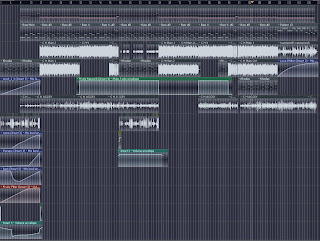
You can tell I went nuts with automation and stuff, and let me tell ya, that filtery-ish intro uses no less than 7 different sound-mangling plugins to get that strange slurpy filtery distortion, working on some already glitched-out vocals that reappear in the middle of the song accompanied by a guitar solo, and at the end. The vocals are from an old Mamie Smith song from the 20s (in the public domain now), which were a last-minute inclusion into the track, and to be honest, the track would have been boring without them.
So, there's plenty more strange interesting music from where that came from! Check it out, bubba!

You can tell I went nuts with automation and stuff, and let me tell ya, that filtery-ish intro uses no less than 7 different sound-mangling plugins to get that strange slurpy filtery distortion, working on some already glitched-out vocals that reappear in the middle of the song accompanied by a guitar solo, and at the end. The vocals are from an old Mamie Smith song from the 20s (in the public domain now), which were a last-minute inclusion into the track, and to be honest, the track would have been boring without them.
So, there's plenty more strange interesting music from where that came from! Check it out, bubba!
lunes, 27 de septiembre de 2010
Musical Maps
Last time I mentioned a musical map, I brought up the wonderful example of Ishkur's Guide To Electronic Music, set in rings akin to those indicating the age in a tree. I was inspired by that map to get on terms with what western music has been up to for the last 100 years (not just electronic music), and truly, there was and still is SO MUCH going on. Really, it's like, if you've just been listening to what's on the radio and MTV, you're missing a whole damn universe of musical colours- and as I began mapping it out realised that with each decade, this musical explosion increases exponentially.
So I based my take on musical history on Ishkur's model, big, concentric rings that mark each decade, beginning with everything before the 40's, extending into the end of this decade. Music's a fuzzy business, you can't create clear-cut boundaries between genres and the labels given to a genre can change over the decades when people look back to older music. Also, I wanted to show music more or less like a web of influences; just like disco got it's flavours from funk, soul and apparently a bit of salsa, funk roots itself in psychedelic rock, soul (again) and jazz. I knew though that I'd have to work on the layout, otherwise it'd be so messy and hard to read that nobody would bother. It's tricky, specially when after the sixties, music exploded into a myriad of styles.
Perhaps too I should have looked at some other examples before embarking on a journey only a few nutty people embark. I looked around the web and found some pretty interesting ways other people have been doing similar things. How does one represent something fuzzy, subjective and ever-changing like music? Maybe the Information Is Beautiful blog has a few things to teach us about clearly visualising information. Here are a few maps from around the web (click on images) :
 So, to begin, I found this one here focusing on the relationships between different kinds of electronic dance music. It leans heavily on the artistic side, but that's not bad at all. Sadly, it's an image I found aaages ago and kept it because I found it pretty, but I never knew out who made it or where I could find it again. But for the meantime, we can marvel at the psychedelic colour mixtures and funky lines linking each genre-bubble.
 INTONE, a music-based marketing company has this particularly interesting layout, genres are like stops on the London underground system, connected to each other by colours representing a similar sound or evolution. I quite like it because of its simplicity; it's easy to read and make immediate connections, some dating to thousands of years (see ''The Drum'', the big black circle bottom-left). Definitely, a good deal of research and careful design planning went into this. It's good for those making the most evident connections, but if you're deep into music connections, it might be a bit too simplistic.
 On a very similar approach, the blokes at The Guardian attempted to map out 100 years of musical evolution, again on a London-tube underground map. This one differs on its approach in that it has artist names instead of styles of music, but the different 'paths' in different colours carry different styles of music. This one focuses solely on western music, particularly Anglo-American music, so don't go looking for merengue, salsa, shibuya-kei or kwaito. Allegedly, this focus was to prevent the editor's head from exploding. Yes, it would look awful with so much. I found it linked here.
 This next, the ''Tourist Map of Music'', impressed me. Unlike all the previous ones, it's actually interactive. You type the name of a band/artist, and in a minimalist blue screen the name you typed appears, and around it the names of similar artists will gravitate and organise themselves, the closer they are to the central name, the bigger the likelihood that fans of the artist/band you typed listen to that too. Pretty awesome! How do they do that?!? I think that with a bit of streamlining, this could definitely be the tool of future music consumers helping them to discover new sounds, because of its ease of use. In the words of the creator, Marek Gibney, ''Gnod'', the system on which this monster thing works, ''is my experiment in the field of artificial intelligence. Its a self-adapting system, living on this server and 'talking' to everyone who comes along. Gnods intention is to learn about the outer world and to learn 'understanding' its visitors. This enables gnod to share all its wisdom with you in an intuitive and efficient way. You might call it a search-engine to find things you don't know about.''
These following two are also interactive and actually let you listen to music in an interactive map-like way. The first one, Musicovery, is everything Yahoo! Radio wasn't. In a deceptively simple set of controls (shown to the left), you can navigate through the emotional and energetic spectrum that is music, through mood (positive to negative) and amount of energy in the music.
  You can also browse through decades and select genres to be more nit-picky. There are a few other features (like a search bar which doesn't actually show what you're looking for) and other things which you'll have to figure out :D. This last 'map' on the right, the SOM-enhanced JukeBox system (SOMeJB) analyses your mp3 files and interprets their sonic properties, namely dynamic range and yeah, how it sounds. Then as seen here, it plots different areas for each style, arranging them according to sound related to each other. That's why classical music and heavy metal are on opposite extremes. See how you can make playlists interactively, taking these paths through different soundscapes!
 (Click for higher resolution and all that nice stuff)
Finally, I could have probably learned a few lessons from the examples above before embarking on the fuzzy history of western music and its genres, but I was trying to be a bit 'different'. Yes, lot's o' nodes and lines connecting stuff, like neurones in a brain, though both frighteningly complicated and somehow organised. Also, I marked all I saw fit into large categories into different colours. Red for rock music, green for jazz. the usual stuff. Yellow for break-beat (that kind of music that was born when hip-hop artists stringed different drum breaks from old funk records and gave birth to a billion things, and blue for 4-to-the-floor, which is simply that basic rhythm where the kick marks the 4 beats in a bar, which was popular in rock but really took off when disco music became the bomb. Also, you might be wondering why in my map, punk (in red) gave birth to this thing I call ''Oh no, you didn't!''. Yeah, I'm being biased there, but I don't think any serious person thinks great things about crunkcore and emo... I'll leave that for a future post on punk music.
So I based my take on musical history on Ishkur's model, big, concentric rings that mark each decade, beginning with everything before the 40's, extending into the end of this decade. Music's a fuzzy business, you can't create clear-cut boundaries between genres and the labels given to a genre can change over the decades when people look back to older music. Also, I wanted to show music more or less like a web of influences; just like disco got it's flavours from funk, soul and apparently a bit of salsa, funk roots itself in psychedelic rock, soul (again) and jazz. I knew though that I'd have to work on the layout, otherwise it'd be so messy and hard to read that nobody would bother. It's tricky, specially when after the sixties, music exploded into a myriad of styles.
Perhaps too I should have looked at some other examples before embarking on a journey only a few nutty people embark. I looked around the web and found some pretty interesting ways other people have been doing similar things. How does one represent something fuzzy, subjective and ever-changing like music? Maybe the Information Is Beautiful blog has a few things to teach us about clearly visualising information. Here are a few maps from around the web (click on images) :
 So, to begin, I found this one here focusing on the relationships between different kinds of electronic dance music. It leans heavily on the artistic side, but that's not bad at all. Sadly, it's an image I found aaages ago and kept it because I found it pretty, but I never knew out who made it or where I could find it again. But for the meantime, we can marvel at the psychedelic colour mixtures and funky lines linking each genre-bubble.
 INTONE, a music-based marketing company has this particularly interesting layout, genres are like stops on the London underground system, connected to each other by colours representing a similar sound or evolution. I quite like it because of its simplicity; it's easy to read and make immediate connections, some dating to thousands of years (see ''The Drum'', the big black circle bottom-left). Definitely, a good deal of research and careful design planning went into this. It's good for those making the most evident connections, but if you're deep into music connections, it might be a bit too simplistic.On a very similar approach, the blokes at The Guardian attempted to map out 100 years of musical evolution, again on a London-tube underground map. This one differs on its approach in that it has artist names instead of styles of music, but the different 'paths' in different colours carry different styles of music. This one focuses solely on western music, particularly Anglo-American music, so don't go looking for merengue, salsa, shibuya-kei or kwaito. Allegedly, this focus was to prevent the editor's head from exploding. Yes, it would look awful with so much. I found it linked here.This next, the ''Tourist Map of Music'', impressed me. Unlike all the previous ones, it's actually interactive. You type the name of a band/artist, and in a minimalist blue screen the name you typed appears, and around it the names of similar artists will gravitate and organise themselves, the closer they are to the central name, the bigger the likelihood that fans of the artist/band you typed listen to that too. Pretty awesome! How do they do that?!? I think that with a bit of streamlining, this could definitely be the tool of future music consumers helping them to discover new sounds, because of its ease of use. In the words of the creator, Marek Gibney, ''Gnod'', the system on which this monster thing works, ''is my experiment in the field of artificial intelligence. Its a self-adapting system, living on this server and 'talking' to everyone who comes along. Gnods intention is to learn about the outer world and to learn 'understanding' its visitors. This enables gnod to share all its wisdom with you in an intuitive and efficient way. You might call it a search-engine to find things you don't know about.''
These following two are also interactive and actually let you listen to music in an interactive
map-like way. The first one, Musicovery, is everything Yahoo! Radio wasn't. In a deceptively simple set of controls (shown to the left), you can navigate through the emotional and energetic spectrum that is music, through mood (positive to negative) and amount of energy in the music. You can also browse through decades and select genres to be more nit-picky. There are a few other features (like a search bar which doesn't actually show what you're looking for) and other things which you'll have to figure out :D. This last 'map' on the right, the SOM-enhanced JukeBox system (SOMeJB) analyses your mp3 files and interprets their sonic properties, namely dynamic range and yeah, how it sounds. Then as seen here, it plots different areas for each style, arranging them according to sound related to each other. That's why classical music and heavy metal are on opposite extremes. See how you can make playlists interactively, taking these paths through different soundscapes! (Click for higher resolution and all that nice stuff)
Finally, I could have probably learned a few lessons from the examples above before embarking on the fuzzy history of western music and its genres, but I was trying to be a bit 'different'. Yes, lot's o' nodes and lines connecting stuff, like neurones in a brain, though both frighteningly complicated and somehow organised. Also, I marked all I saw fit into large categories into different colours. Red for rock music, green for jazz. the usual stuff. Yellow for break-beat (that kind of music that was born when hip-hop artists stringed different drum breaks from old funk records and gave birth to a billion things, and blue for 4-to-the-floor, which is simply that basic rhythm where the kick marks the 4 beats in a bar, which was popular in rock but really took off when disco music became the bomb. Also, you might be wondering why in my map, punk (in red) gave birth to this thing I call ''Oh no, you didn't!''. Yeah, I'm being biased there, but I don't think any serious person thinks great things about crunkcore and emo... I'll leave that for a future post on punk music.
''Out on the edges they're mixin' the colors some they don't like it but me, I don' t mind in every city they' re mixing the colors different shades for the whole countryside''
Mixin' The Colors - Iggy Pop
Edit:
Apparently this cool map here escaped my search: Map of Metal
A really cool flash-based map of the history of heavy metal and it's different genres, loaded with tons of music samples and descriptons. Also, it looks like jeans, leather, badass buttons and chains. What else could you ask for?
Mixin' The Colors - Iggy Pop
Edit:
Apparently this cool map here escaped my search: Map of Metal
A really cool flash-based map of the history of heavy metal and it's different genres, loaded with tons of music samples and descriptons. Also, it looks like jeans, leather, badass buttons and chains. What else could you ask for?
jueves, 23 de septiembre de 2010
Black Metal v.s. Death Metal
 When telling apart two closely-related genres of extreme music, sometimes, it's not the best thing to ask someone who is a hardcore fan. To illustrate the kind of confusing answers I got when asking the difference between black metal and death metal, I'll use the answer a close friend of mine gave me:
''Death metal has more of a 'black' influence in it, while Black metal has more of a 'death' influence''.
Uh-uh... I remember we had a fight, although not because of arguing, but because I found it so ridiculous anybody would seriously make such silly labels, and make one label the definition of the other one. If you don't know much about rock music (let alone heavy metal), it's quite likely that they will all sound the same to you. It's like me, I'm not really familiar with all the different kinds of, say, East European folk music styles, so maybe they'd all sound the same to me. Or to put it in more familiar terms to 'westerners', particularly people over 30, all electronic music (so labelled 'techno') sounds the same. (''How dare they call drum & bass something so dirty as techno or electronica!'' might be a d&b fan's reaction).
 To be honest, while I have been listening to heavy metal (and playing it) since around I was 15 or maybe even before, I still can't tell black and death apart when someone plays a bunch of tracks of both genres. At face value, the word 'black' is just a metaphor for 'death' anyway. And perhaps I didn't (and still don't) care enough to really do. Oh, and I preferred progressive and experimental kinds of metal to black/death anyway.
If you read this far, chances are you probably like the music at least a teeny weeny bit. Or hate it bigtime and you're up for some trollin'. If you listen only to what's top 40, do not, I repeat, DO NOT play the following video. Not only will you find it all terrible, you will not be able to tell the difference between death metal and black metal... OK, after listening to it I too was left clueless.
So, you're not crying, your ears are not bleeding and you did not have a breakdown. Congrats. Of course I'm blowing it out of proportion anyhow. It WILL be like sandpaper to the ears of some people 'cause maybe that's the point.
After seeing several people's definitions and stuff, I think maybe I'd say that the line is blurry as hell, but when both kinds of music were born, they were a lot more different. Nowadays a lot more mixing of styles occurs anyway. So, here's the idiot's guide to sounding like you know what is the difference between Black Metal and Death Metal:
The Idiot's Guide To Sounding Like You Know What the Difference is Between Black Metal and Death Metal
Themes:
 It seems to be widely accepted that a large part of what it is to be 'black metal' has to do with being anti-Christian and/or Satanic/Pagan/whatever (note the use of and/or). Black Metal is more of an ideology, just like some ridiculous punk sub-genres out there, such as Queercore, Riot Grrrl, Oi!, Nazi Punk, Christian-democrat-pro-life-Punkcore, etc.... Nihilism, depression and misanthropy also seem to be staple themes in Black Metal. Also, confusingly, they talk about death too. Huh.
 Death metal, on the other hand, tends to focus more on negative
 emotions, sorrow, frustration, social alienation, but in a much more serious and dark way than the blues. Consequently, stuff like necrophilia, torture, rape and the suffering of the human soul are frequent subjects. Not saying that many Death Metal lyricists have ACTUALLY suffered in such ways... Also, like its name, death metal focuses on mortality and death. That's right, Death Metal is pretty much headbanging to a Memento Mori. What's more confusing is that while Death Metal frequently uses slasher movie-style violence in it's lyrics, it can also be about Satanism, anti-religious things and philosophy, just like Black Metal. Huh.
Musical style:
Alright, from the video above you might have thought: ''Yo, I can't tell them apart''. And yea, I guess you could say it doesn't really make a difference on this wide vast Earth. Unless you're a fan... Here's some interesting imagery used by a random internet user to describe what each 'sounds like':
''Death metal sounds like the reaper comming to war
Black metal sounds like a gothic castle filled with blood and the howls of suffering souls.''
Black metal sounds like a gothic castle filled with blood and the howls of suffering souls.''
Okay, that's nice, but if you're into the more musicological take on the distinction, here's the more or less controversial definition I formed after reading several people talk about it:
The vocals in Death Metal, ''death grunts'' or ''growls'', are usually deep and aggressive. I can't make out a word they say most of the time. Neither can I for Black Metal, which uses high-pitched shrieks, screams and snarls which seem to imitate, like in the clever imagery above, souls in anguish and that kind of crap. Could someone maybe pick a pitch in the middle?
Song structure and melodic/harmonic content seem to actually define both kinds of music a lot more than theme. In both kinds of music, traditional song structure is eschewed, yielding some unconventional things. More clearly said, Death Metal favours weirdass song structures with frequent tempo and key changes, while Black Metal favours unconventional songs where the verse-chorus distinction is not very clearly emphasised and long and repetitive stuff goes on. Y'know, if you had some sort of pagan ritual, you'd want to have some repetitive, jarring music that would put you in trance (or coma?). Thinking about it, Black Metal almost seems to be like funeral march music, with a languishing, militaristic and sombre feel, while Death Metal focuses more on the violence that came before said death, hence, it's more like a battlefield.
Death Metal seems to care more about the instruments and skills than Black Metal, which has more textural and atmospheric sensibilities. It's all about that dark nasty feel that gives ya chills, bro. Black Metal tends to be more melodic than Death Metal as a consequence. They revel in dark and ominous chord progressions and the use of the tritone, more aptly, Diabolus in Musica. All hail dissonance as a stylistic choice! But wait, Death Metal likes dissonance too sometimes. More like free jazz in the sense that it can be atonal (not follow any particular key or scale), or championing the use of chromatic runs. However these differences are trivial. Now there's so much Melodic Death Metal and Blackened Death Metal that these things become meaningless.
Black Metal guitars are pretty standard, just very fuzzy and lo-fi it seems. Low guitar tunings are very rare, strangely for a kind of music that wants to sound ominous. Guitars are often heavily downtuned in Death Metal, all the way down, so that the E string resonates a thick, heavy, chugging C (some bands even go as far as tuning all the way to B). Classic example of a riff where only the deep C power chord is used is Children of Bodom's 'In your face': (note that this is Melodic Death Metal, obviously, it emphasizes melodies unlike noted above)
Also, in Black Metal, technicality is frowned upon; guitarists seem to find guitar solos pointless, so go hoping you'll find many in their music. Death Metal, however, like it's grand-daddy Thrash Effin' Metal, is obsessed with solos. As I said above, it's the kind of music that emphasises prolific musicianship, you must have the chops for this kind of music (not that you can be a crappy Black Metal guitarist and get far).
Bass guitar as an aspect of heavy metal tends to be quite limited. In Black Metal, it is practically nonexistent; it plays riffs identical to the rhythm guitars most of the time and on top of that, it is buried so deep within the mix that it's inaudible. Death Metal features it a bit more, but I'm not quite sure the differences are significant... anyone know?
Other instruments such as keyboards are more prominent in Black Metal than in Death Metal (unless we include Melodic varieties where it's more common). These usually give the music an ambient feel, usually via some ethereal strings, haunting pads or whatever.
The final musicological comparison comes to the aesthetic of the music and its production in the studio; Death Metal doesn't seem to mind having polished, crisp recordings where every instrument stands out, while Black Metal is as lo-fi as you can get, most bands will at least once during their early years recorded everything in the drummer's basement, some get everything recorded into one track and don't edit it at all. This DIY aesthetic is very punk itself, it's all about getting it as raw as possible. More 'mainstream' bands like Dimmu Borgir who play Black Metal with symphonic elements in it have a higher production quality, and for that reason a few stuck-up hardcore fans of traditional Black Metal will claim they sold out and that they aren't real Black Metal. Who cares? The people who recorded stuff in their basements did it for their own pleasures anyway.
But wait! What about the drums, just as important in any kind of modern music? True, I almost forgot. Well, Death Metal drummers almost universally use a double bass pedal or will have two bass drums to create that rapid-fire pummelling kick rhythm. In addition to the double bass barrage, blastbeats are heard too. Yes, they take drums seriously. The thing here is that both Black Metal and Death Metal share a great deal in the percussion department. Any major differences, I'm not sure.
And yeah, for those not sure what a blastbeat sounds like, here's an example, the first two bars are more normal double-pedal rhythms, the third and fourth bars show the blastbeats, the repeating snare-hihat-kick beating:
I could keep going about the subject but methinks this is enough. If you want to listen to more music there's the video below, but I won't go into silly stuff such as why in Black Metal, silly costumes are more frequent, or who's blamed for church burnings (no finger pointing here), who's more often portrayed (with evidence or none) racist or anything. Black and Death bands take themselves way too seriously anyway.
Perhaps it's fascinating, dunno. I don't think it's healthy to dwell in negative crap all your life like there's nothing else left. As human beings, I think it's essential that we do something to stimulate other people's thoughts, ignite imagination, instil a culture of love unto the coming generations and to strive for peace of mind and soul. This music, in the long history of mankind, is just a phase, a counter-wave to some other thing that happened before. Put into the perspective of the thousands and thousands of years of human history, it's all contrived, silly. My advice, just listen to these kinds of music for your auditory pleasure. Beyond that, move on. Strive for your full potential.
P.S.; I'm not saying that Black/Death musicians are negative, anti-religious, resented or a combination of any of them. I know, music since time immemorial has been an outlet- consider the slave's work chants, a way to lessen the burden of working under the hot sun picking cotton. But then, I find it funny, how many metal musicians that portray such suffering in their music have had it that rough? Not generalising though, the ones who did, you guys, deserve a round of applause if you made it through.
domingo, 19 de septiembre de 2010
Venezuelan DnB makes fun of Reggaeton
Searching stuff on Youtube I stumbled across a video many many people will hate, because it fuses two genres which in my opinion, are angularly different in spirit and idea; reggaeton and drum & bass. DJ Zardonic is a drum & bass artist from Venezuela who is probably familiar enough with reggaeton to understand it and express it in the medium of d&b:
Tito El Bambino - Siente el Boom (Zardonic D&B mix)
Many D&B fans hated the idea of 'polluting' their style of music with this. Maybe it doesn't have the slow swaying thumping military quality of the original hit (which is a pretty crappy song I feel), and instead is really really upbeat, perhaps so upbeat that the idea of perreo (the doggystyle dance ubiquitous in reggaeton) would be ridiculous. Also, I noticed that the typical drum & bass rhythm actually has more affinity with reggaeton than I would have suspected at the beginning. To begin with, the tempos are so similar, that is, moderate reggaeton (100 bpm) will go along with a fast drum & bass rhythm (200 bpm), and of course, the more typical 170 bpm or d&b matches with the slower reggaeton tracks (around 85 bpm which is quite slow, only things like crunk play at slower speeds; 75 bpm).
Second, the typical reggaeton rhythmic pattern (known commonly as the Dembow) is prety much the inverse of the typical jungle rhythm! What do I mean by inverse? The fact that if one switched the bass drum with the snare drum in a reggaeton beat you could get a d&b rhythm.
Here we have the typical reggaeton rhythm, played at around 91 bpm:

Note that reggaeton, like its precursor, dancehall and all the styles of popular dance music that came after and before such as disco, house, dub and trance, it is characterised by a kick drum that marks every 4 beats in a bar (only 2 beats seen here). While in those music styles, the snare marks the offbeats usually, in reggaeton the first offbeat is slightly shifted giving the music a bouncy feel.
If we change the pattern so that the kick drum plays the pattern of the snare and vice-versa (as shown below), like magic, we get a basic drum and bass rhythm. The kick drum no longer marks every beat, but the snare marks every offbeat.

However, the beat is slightly shifted (the kick doesn't begin at the start of the bar), so if we move everything a beat and a half to the left, we truly get the backbone to most d&b out there:

While to me it seems that reggaeton has a strong emphasis on the downbeat (beats 1 & 3 in a bar), drum & bass, while complex it seems to carry an emphasis on the offbeat which it inherits from hiphop (ultimately, the rhythm is like the foundations it got from the Amen Break, as everybody knows, the most famous drumbreak in the history of drumbreaks).
Two styles of music created in very different places with quite different cultures which however share many of the same roots.
Drum & bass is a more commercial, slick, produced version of ragga jungle that appeared in the UK, making the Amen Break secondary to the beat and more like a background filling to the beat illustrated above. Ragga came from the Jamaican toasting (from where hiphop also sprung back in the early 80s), taking in reggae along with it, deep basslines and sped-up Amen breaks.
Reggaeton, well, was dancehall music from Jamaica adapted into the Spanish communities of Puerto Rico and Panama, infused with the specific style of rapping/toasting they developed. Where did the Dembow rhythm come from? Shabba Rank's song Dembow seems to have been the first to have made it famous but it probably dates waaay back into reggae music and from Afro-Latin roots.
Note that along with early Ragga music from which D&B eventually arose, early Reggaeton had a very lo-fi, raw quality, something BOTH drum & bass and reggaeton lost as they developed into popular commercial music. Maybe Jamaica's involvement in the origins of both styles of music serves as a bridge strong enough to allow DJ Zardonic's remix above and other kinds to be possible. Interesting in all of this might be how we can dig back into history and see when they were one kind of musical idea.
So, closing this rather long and unstructured post, I leave you with DJ Zardonic's main page and his other musical projects, in addition to a little musical ''sketch'' of the commonalities between both genres I made this morning rather quickly (strangely enough it was before I found out about the beat-inverting thing or Zardonic's beat juggling in the remix at the beginning of the post):
http://www.myspace.com/djzardonic (industrial drum & bass with a metal touch)
http://www.myspace.com/triangularascension (dark ambient music)
http://www.myspace.com/moreonklipp (minimal house)
Tito El Bambino - Siente el Boom (Zardonic D&B mix)
Many D&B fans hated the idea of 'polluting' their style of music with this. Maybe it doesn't have the slow swaying thumping military quality of the original hit (which is a pretty crappy song I feel), and instead is really really upbeat, perhaps so upbeat that the idea of perreo (the doggystyle dance ubiquitous in reggaeton) would be ridiculous. Also, I noticed that the typical drum & bass rhythm actually has more affinity with reggaeton than I would have suspected at the beginning. To begin with, the tempos are so similar, that is, moderate reggaeton (100 bpm) will go along with a fast drum & bass rhythm (200 bpm), and of course, the more typical 170 bpm or d&b matches with the slower reggaeton tracks (around 85 bpm which is quite slow, only things like crunk play at slower speeds; 75 bpm).
Second, the typical reggaeton rhythmic pattern (known commonly as the Dembow) is prety much the inverse of the typical jungle rhythm! What do I mean by inverse? The fact that if one switched the bass drum with the snare drum in a reggaeton beat you could get a d&b rhythm.
Here we have the typical reggaeton rhythm, played at around 91 bpm:
Note that reggaeton, like its precursor, dancehall and all the styles of popular dance music that came after and before such as disco, house, dub and trance, it is characterised by a kick drum that marks every 4 beats in a bar (only 2 beats seen here). While in those music styles, the snare marks the offbeats usually, in reggaeton the first offbeat is slightly shifted giving the music a bouncy feel.
If we change the pattern so that the kick drum plays the pattern of the snare and vice-versa (as shown below), like magic, we get a basic drum and bass rhythm. The kick drum no longer marks every beat, but the snare marks every offbeat.
However, the beat is slightly shifted (the kick doesn't begin at the start of the bar), so if we move everything a beat and a half to the left, we truly get the backbone to most d&b out there:
While to me it seems that reggaeton has a strong emphasis on the downbeat (beats 1 & 3 in a bar), drum & bass, while complex it seems to carry an emphasis on the offbeat which it inherits from hiphop (ultimately, the rhythm is like the foundations it got from the Amen Break, as everybody knows, the most famous drumbreak in the history of drumbreaks).
Two styles of music created in very different places with quite different cultures which however share many of the same roots.
Drum & bass is a more commercial, slick, produced version of ragga jungle that appeared in the UK, making the Amen Break secondary to the beat and more like a background filling to the beat illustrated above. Ragga came from the Jamaican toasting (from where hiphop also sprung back in the early 80s), taking in reggae along with it, deep basslines and sped-up Amen breaks.
Reggaeton, well, was dancehall music from Jamaica adapted into the Spanish communities of Puerto Rico and Panama, infused with the specific style of rapping/toasting they developed. Where did the Dembow rhythm come from? Shabba Rank's song Dembow seems to have been the first to have made it famous but it probably dates waaay back into reggae music and from Afro-Latin roots.
Note that along with early Ragga music from which D&B eventually arose, early Reggaeton had a very lo-fi, raw quality, something BOTH drum & bass and reggaeton lost as they developed into popular commercial music. Maybe Jamaica's involvement in the origins of both styles of music serves as a bridge strong enough to allow DJ Zardonic's remix above and other kinds to be possible. Interesting in all of this might be how we can dig back into history and see when they were one kind of musical idea.
So, closing this rather long and unstructured post, I leave you with DJ Zardonic's main page and his other musical projects, in addition to a little musical ''sketch'' of the commonalities between both genres I made this morning rather quickly (strangely enough it was before I found out about the beat-inverting thing or Zardonic's beat juggling in the remix at the beginning of the post):
http://www.myspace.com/djzardonic (industrial drum & bass with a metal touch)
http://www.myspace.com/triangularascension (dark ambient music)
http://www.myspace.com/moreonklipp (minimal house)
jueves, 9 de septiembre de 2010
Rock Band Logos, Black Metal Band Logos
Me being interested in design (brand design, graphic design, creative stuff), I could post about the best company logos out there, though that would be a cliché (and Apple's logo would probably be on the top 5). Instead, here's an interesting facet of brand design; the design of logos that identify musical groups. Since they beat me to it, I'm not gonna reinvent the wheel here and show off the work of these two blogs.
 The first one gives us a list of logos by some of the greatest rock bands out there. Did they have an influence on their career? Chances are that it's a big deal. Check the 10 Top Rock Band Logos, and their history, yo!
 On the other hand, it seems that black metal acts strive for some way to be as unrecognizable as possible, disguised in a lame excuse of 'aesthetics of death'. See if you can figure out what's in each logo! Whee!
The first one gives us a list of logos by some of the greatest rock bands out there. Did they have an influence on their career? Chances are that it's a big deal. Check the 10 Top Rock Band Logos, and their history, yo!On the other hand, it seems that black metal acts strive for some way to be as unrecognizable as possible, disguised in a lame excuse of 'aesthetics of death'. See if you can figure out what's in each logo! Whee!
martes, 31 de agosto de 2010
Sxip, you rock socks all over the world!
 Sxip (pronounced 'skip') is a multi-instrumentalist genius who makes his own instruments out of stuff. He appeared in the goddarn weird but funny Insane Yeti Squirrel comic strip a while back.
At first it seemed like another crazy guy who does experimental stuff, but he's one of the few to do so compellingly, methinks.
Beatboxing, guitar playing, and weird sound effects, heck, I wonder, he does them all live yet I wonder how he gets all those sounds. Watching some of his stuff I initially thought he was playing along a backing track of sorts or using special effects!
So, without further ado, I present the one and only Sxip Shirey:
Moon In Her Belly (featuring the amazizing Adam Matta)
Pandora
In a song with Jason Webley (must check him out one day) - Days With You
Few people are able to do all these wildly different things with all kinds of people, have a blast and make awesome stuff... you heard me, Britney Spears- take note.
 Now, you might not remember him by his music in that case (maybe by his mad scientist hairdo), but it's kickass music. I loved his new CD, Sonic New York. It sounds as if all the different grooves and melodies of the city that never sleeps had slept together and had a million babies. Truly some kind of thing that's not heard often. A bit Bowie-ish, Zappa-ish with everything in between! Will buy sometime :D
lunes, 30 de agosto de 2010
Dj Shackles . Crazy Dubmetalstep thingy
Dubstep is a new kind of thing to me, even though it's been around for like a decade now (as if I'd listen to music through the web when I was nine...), and I've been growing to like it a lot. I dunno, it can be harsh, heavy, it can make you wanna get up and shake your goddamn booty or get you into a trance. And still I don't really know how to describe the music since it all sounds so different... isn't that great? Not like other kinds of music (gangsta rap, reggaeton, metalcore and trance, you all heard me).
So! Dj Shackles (what a name) makes some grindingly heavy dubstep that occasionally sounds more like heavy metal, really, really dancy heavy metal. Anyway listen for yourself this oddity:
SHACKLES - WOLVES AMONG SHEEP by SHACKLES
The mixture is cool, the drums alternate between realistic heavy metal drumwork and more dubstep-ish sounds. The guitars sound a little glitchy for my taste.
Here it almost feels like it could lead nicely into a DnB track but he artfully brings all the weird crap that makes dubstep dubstep. Interesting indeed:
SHACKLES - DARK HARMONIX by SHACKLES
So! Dj Shackles (what a name) makes some grindingly heavy dubstep that occasionally sounds more like heavy metal, really, really dancy heavy metal. Anyway listen for yourself this oddity:
SHACKLES - WOLVES AMONG SHEEP by SHACKLES
The mixture is cool, the drums alternate between realistic heavy metal drumwork and more dubstep-ish sounds. The guitars sound a little glitchy for my taste.
Here it almost feels like it could lead nicely into a DnB track but he artfully brings all the weird crap that makes dubstep dubstep. Interesting indeed:
SHACKLES - DARK HARMONIX by SHACKLES
viernes, 27 de agosto de 2010
Ishkur's Guide to Electronic Music
Trance? Techno? House? Jungle? Hardcore? What's the difference between them anyway? They all sound like un-tss un-tss because all electronic dance music does so. I found this neat little (massive) guide to electronic music made by some mysterious person by the alias 'Ishkur'. Pretty cool, years are like the rings inside a tree trunk and different music styles that split and form nodes and crazy lumps and things and you can hear examples of each style of music and learn how sounds change through the ages and travel different cultures. Although in the last 10 years there has been an explosion of new styles of music (dubstep, reggaeton that has actually been around for a while, this new trancey DnB sound and a resurgence of electro), the guide still kicks ass an is not that out of date. How much work was put into it!

lunes, 23 de agosto de 2010
My current obsession with flamenco guitar
As my next album nears completion, there's a track that was a bit like flamenco that I decided to re-record. It wasn't that bad, but I lost the original files and couldn't polish the mix, so I opted for doing the whole thing again. And me being me, I dived into the world of flamenco guitar and listened to Paco de Lucía for hours. I'm really getting into this; it's so much fun playing this kind of music, but it's also as hard as feck.

So, in my quest to unlock gypsy and middle-eastern roots in my Spanish guitar, I've found tons and tons of flamenco techniques that I had no idea about. It's amazing how many awesome ways of making the guitar sing exist!
So here are the ones that really really got me:
Golpe technique:
Rumba flamenca:
Rasgueado (the most known one):
Different Rasgueado:
Bulerías (this is the hardest one I've found, aghh!!)
Crazy-ass mofo comes up with a flamenco-ish technique when trying a Victor Wooten slap bass thing:
Using ''picado'' (fingerpicking) to play arpeggios:
So yeah... I've had my hands doin' these crazy gitano things lately, and also, this has sparked my interesting in Gypsy music. Last Friday was listening to things ranging from Django Reinhardt's gypsy jazz music to Bulgarian wedding music, seriously some of the craziest and most awesome music in the world!


So, in my quest to unlock gypsy and middle-eastern roots in my Spanish guitar, I've found tons and tons of flamenco techniques that I had no idea about. It's amazing how many awesome ways of making the guitar sing exist!
So here are the ones that really really got me:
Golpe technique:
Rumba flamenca:
Rasgueado (the most known one):
Different Rasgueado:
Bulerías (this is the hardest one I've found, aghh!!)
Crazy-ass mofo comes up with a flamenco-ish technique when trying a Victor Wooten slap bass thing:
Using ''picado'' (fingerpicking) to play arpeggios:
So yeah... I've had my hands doin' these crazy gitano things lately, and also, this has sparked my interesting in Gypsy music. Last Friday was listening to things ranging from Django Reinhardt's gypsy jazz music to Bulgarian wedding music, seriously some of the craziest and most awesome music in the world!
miércoles, 11 de agosto de 2010
Polyrhytms in pop music
I tend to avoid the music in the radio; it's derivative ballads and reggaeton, overproduced and uninspired music of all sorts, dance-rock-rap, all the things under the 'pop' umbrella term. Sure, there are amazing songs now and then which are pop and not all pop is inherently bad, but most is inherently... stupid.
It's probably just the fault of the people who listen to things and vote. ANYWAY, sometimes interesting things do get through.
I'm not a J-Pop fan at all. But this to me seemed awesome. You know why? No, it's not because prettygirlsstupidcostumeseverythingprettyprettycutekawaiiblargh, but because of that genius bridge in the song that sounds like NOTHING ANYWHERE ON ANY POP CHART AROUND THE WORLD.
Note: it starts at around 1:37.
I guess that the 'Poririzumu' (Polyrhythm) bridge is appropriate, something about love being like two different rhythms playing at the same time. Moving on from that, Marty Friedman approves this song. Therefore, he made a cover with the awesomeness only he can give:
I think I would have liked it more if that crazy part had been used more than just in the bridge of the song and in the end. Or make the end as beat-heavy as the first bridge. Oh well, it's a start. I didn't like how lifeless the voices sounded. But hey, most pop music tends to be lifeless!
It's probably just the fault of the people who listen to things and vote. ANYWAY, sometimes interesting things do get through.
I'm not a J-Pop fan at all. But this to me seemed awesome. You know why? No, it's not because prettygirlsstupidcostumeseverythingprettyprettycutekawaiiblargh, but because of that genius bridge in the song that sounds like NOTHING ANYWHERE ON ANY POP CHART AROUND THE WORLD.
Note: it starts at around 1:37.
I guess that the 'Poririzumu' (Polyrhythm) bridge is appropriate, something about love being like two different rhythms playing at the same time. Moving on from that, Marty Friedman approves this song. Therefore, he made a cover with the awesomeness only he can give:
I think I would have liked it more if that crazy part had been used more than just in the bridge of the song and in the end. Or make the end as beat-heavy as the first bridge. Oh well, it's a start. I didn't like how lifeless the voices sounded. But hey, most pop music tends to be lifeless!
lunes, 26 de julio de 2010
Country Metal?
One makes your head explode (as in Mars Attacks!) while the other makes you headbang (as in Metallica). Okay, not all country is bad, but there's awful country out there. The same can be said of heavy metal (although I like metal a lot more).
Even though both styles have great affinity for some things and after all, share many of the same roots, I've heard relatively little mingling between them. Let's face it; if a band leads the way in an imaginary 'Country Metal' genre, or 'Countrycore' (god I hate the -core suffix), chances are that it's forever labelled as 'cheesy', 'godawful', or a shame in the name of metal. However, I think there have been a few instances that I think could lead to some kind of interesting cool music based on both. Coming from a mix of heavy metal and southern rock, Black Label Society had the damn catchy "House of Doom" track, for instance:
From "Hangover Music, Vol VI".
Okay, it isn't country, but southern rock is well, a fusion of rock & roll, blues and country music! I think that it may be good as a platform to further mingling between country and heavy metal.
Other ways would be through punk music and that very very bouncy hill-billy stuff. Here, for instance, punk band Guttermouth created something really unique; that "barnyard" sort of rhythm fits punk and some kinds of country/folk excellently. Note the awesome violin and banjo interplay in the background and their solos:
I'm Destroying the World from "Covered in Ants".
Kid Rock seamlessly mixed southern rock, hip hop and not-quite-metal in "Cowboy", so figure, you can remove the 'breakbeat' influence and turn the metal one up a notch. It's not a bad song, considering that he managed to mix 3 things so well (when many nu-metal bands suck and they don't even mix country):
Song from "Devil Without a Cause".
Rebel Meets Rebel, with their eponymous track, to me seems to be real Heavy Country (or whatever), however, I'm not quite sure about that fiddle lead before the verses... they are annoying. They could sound a lot better. However, the vocals here, specially when they harmonise bring out tons of potential. Hmm, I think it's okay. Here we go:
From Rebel Meets Rebel album.
It gets better towards the end with that fiddle breakdown solo double-timey part.
"Coyboys Do More Dope" by Rebel Meets Rebel:
Quite like the piano there...
Now, the guitar-shredding angle of music is a good way to immerse into the world of country music. It may get a bit tiring after a while (like most country), but it's briefly the coolest thing in the universe:
We also have another band a bit like Rebel Meets Rebel but maybe a bit more palatable to some; Haf Bitten Moon:
Finally, I'll leave y'all with these two funnies. Meh...
Even though both styles have great affinity for some things and after all, share many of the same roots, I've heard relatively little mingling between them. Let's face it; if a band leads the way in an imaginary 'Country Metal' genre, or 'Countrycore' (god I hate the -core suffix), chances are that it's forever labelled as 'cheesy', 'godawful', or a shame in the name of metal. However, I think there have been a few instances that I think could lead to some kind of interesting cool music based on both. Coming from a mix of heavy metal and southern rock, Black Label Society had the damn catchy "House of Doom" track, for instance:
From "Hangover Music, Vol VI".
Okay, it isn't country, but southern rock is well, a fusion of rock & roll, blues and country music! I think that it may be good as a platform to further mingling between country and heavy metal.
Other ways would be through punk music and that very very bouncy hill-billy stuff. Here, for instance, punk band Guttermouth created something really unique; that "barnyard" sort of rhythm fits punk and some kinds of country/folk excellently. Note the awesome violin and banjo interplay in the background and their solos:
I'm Destroying the World from "Covered in Ants".
Kid Rock seamlessly mixed southern rock, hip hop and not-quite-metal in "Cowboy", so figure, you can remove the 'breakbeat' influence and turn the metal one up a notch. It's not a bad song, considering that he managed to mix 3 things so well (when many nu-metal bands suck and they don't even mix country):
Song from "Devil Without a Cause".
Rebel Meets Rebel, with their eponymous track, to me seems to be real Heavy Country (or whatever), however, I'm not quite sure about that fiddle lead before the verses... they are annoying. They could sound a lot better. However, the vocals here, specially when they harmonise bring out tons of potential. Hmm, I think it's okay. Here we go:
From Rebel Meets Rebel album.
It gets better towards the end with that fiddle breakdown solo double-timey part.
"Coyboys Do More Dope" by Rebel Meets Rebel:
Quite like the piano there...
Now, the guitar-shredding angle of music is a good way to immerse into the world of country music. It may get a bit tiring after a while (like most country), but it's briefly the coolest thing in the universe:
We also have another band a bit like Rebel Meets Rebel but maybe a bit more palatable to some; Haf Bitten Moon:
Finally, I'll leave y'all with these two funnies. Meh...
lunes, 12 de julio de 2010
Weaving Goddamn Webs
Do you use Twitter? Perhaps, if you have the time to indulge in such things. Facebook? Probably unless you're worried about privacy and well, you realise that nobody really needs one. A blog? Like this one or something else (even if it's the lame Fotolog)? If you have more than one account on anything in the web it probably means you have the time for that. I am sick of it, I don't want to sift through Facebook messages, or in any other social website (I have Multiply and it's the same story...). There's a lot more important work outside to do.
''But dude, then what are you doing posting on this blog then?''
Takes less time. Nobody else needs to have an account to comment. No hassle. Dunno, I thought it was a cool idea when I started it. I thought the same out of this stupid Formspring account but it seems it's dead. You can ask me something but who are we kidding, eh? The Multiply account I mentioned before, also. It was a nice place where to post random things, a lot like this place too. I befriended a couple of people there from all over the world and share things about anything. Really nice and fun people. Although we're all just online identities here, it's a shame maybe. I feel clogged up with all this stuff.
But then, Google Sites came in handy. It's like my own portable bookmarks page with anything I find useful. So that's more personal.
But then things mount up! For instance, my music project at Reverbnation, and then I'm releasing the music in Bandcamp too! Aaargh! It seems like it may save some time or be helpful promoting the music, but this is maybe a bit too much.
Then there's DeviantArt. I'm okay with it... I won't complain...
*coughlotsofmessagescoughcough*
However, there's an even more pressing issue here; if you've everywhere, it may be good when you're trying to promote something (so far my music and art provide me zero income), but it also makes you vulnerable to being found, um, and many other things. Here's Juanelo (in Spanish and translated below) summing up an important idea!


Juanelo belongs to Marco Canepa. All rights reserved. Vida larga a Juanelo.
''But dude, then what are you doing posting on this blog then?''
Takes less time. Nobody else needs to have an account to comment. No hassle. Dunno, I thought it was a cool idea when I started it. I thought the same out of this stupid Formspring account but it seems it's dead. You can ask me something but who are we kidding, eh? The Multiply account I mentioned before, also. It was a nice place where to post random things, a lot like this place too. I befriended a couple of people there from all over the world and share things about anything. Really nice and fun people. Although we're all just online identities here, it's a shame maybe. I feel clogged up with all this stuff.
But then, Google Sites came in handy. It's like my own portable bookmarks page with anything I find useful. So that's more personal.
But then things mount up! For instance, my music project at Reverbnation, and then I'm releasing the music in Bandcamp too! Aaargh! It seems like it may save some time or be helpful promoting the music, but this is maybe a bit too much.
Then there's DeviantArt. I'm okay with it... I won't complain...
*coughlotsofmessagescoughcough*
However, there's an even more pressing issue here; if you've everywhere, it may be good when you're trying to promote something (so far my music and art provide me zero income), but it also makes you vulnerable to being found, um, and many other things. Here's Juanelo (in Spanish and translated below) summing up an important idea!

Juanelo belongs to Marco Canepa. All rights reserved. Vida larga a Juanelo.
lunes, 28 de junio de 2010
Madrugal
 I was listening to Café Tacuba the other day when a seemingly innocent and inconspicuous bolero-style song in their 2nd album, Re, which caught my ears. Not because of the intricate and smooth guitar, or the sweet voices that are complemented by it, but by the last line of the song. Overall it's a jab at pollution in Mexico city, using irony. Here's the song in the original and also my translation:
La ciudad de los palacios
The city of palaces
Va dejando paso a el albaGives way to dawn
Se va perdiendo la calmaCalm recedes
Para cuando el sol asomaBy the time the sun peeps
Todo el esplendor decreceAll the splendour diminishes
la gente en las calles tomapeople in the streets drink
Catedral desaparece entre smog(the) cathedral dissapears among smog
Y caca de paloma.and pidgeon shit.
-----------------------------------------------------------------------
What an awesome way to end the song, eh?
Now, 'Madrugal' probably means 'Morning Song' or something. What happens is that it's not really a word, and after searching around for the definition, the closest thing I found was the Italian term, madrigal. According to the Free Online Dictionary, madrigal means the following:
1. a. A song for two or three unaccompanied voices, developed in Italy in the late 13th and early 14th centuries.
b. A short poem, often about love, suitable for being set to music.
2. b. A part song.
A portmanteau (word made out of two different words), perhaps? I quite like the idea, a short morning poem sung by polyphonic voices, set to music. Although, it strikes to me as some kind of prose really similar to what a haiku would be. EDIT: (Thank you, pla, you are right, it's more senryu actually!). After all, it's a 'show, not tell' kind of thing, it paints a vivid image in the mind of the reader/listener and with just a few words it can do a lot. Of course this is 4 lines a stanza, but I think the parallels are interesting!
Suscribirse a:
Entradas (Atom)